
Optics
Covering key areas such as geometric optics, colorimetry, radiation and luminescence, radiometry and photometry, providing theoretical support for imaging principles.
Geometric Optics
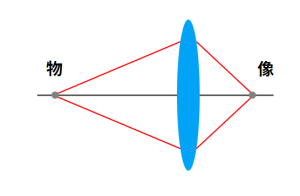
Geometric optics uses light rays as an abstract model to describe the laws of light propagation, ignoring wave effects of light, and does not consider diffraction, interference, and polarization phenomena. Based on Fermat's Principle, it derives the basic laws of Rectilinear Propagation, Reflection, and Refraction. It serves as the underlying theoretical support for imaging system analysis (e.g., parameters like Entrance Pupil, Depth of Field, Maximum Image Circle), lens selection, and imaging quality impact assessment (e.g., vignetting due to CRA mismatch, edge darkening due to insufficient MIC, etc.).
Colorimetry
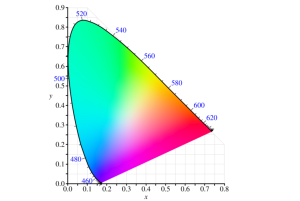
Colorimetry is the discipline of quantifying and measuring color. With the CIE Standardized Colorimetric System as its core theoretical framework, it transforms subjective human color perception into objective physical values for quantitative calculation. Its scope of research includes key theories such as color tristimulus values, chromaticity coordinates, Color Rendering, and Metamerism. It provides a unified measurement standard for high-precision color reproduction in equipment and media across various fields such as displays, lighting, and printing.
Radiation and Luminescence
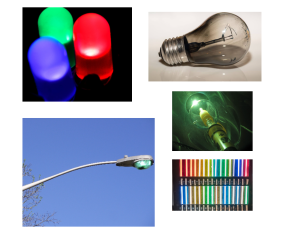
Focusing on the luminescence mechanisms of thermal radiators, gas discharge sources, and solid-state light sources, and based on the theory of Blackbody Radiation, it analyzes the core characteristics of typical light sources such as LEDs, fluorescent lamps, and incandescent lamps. Combining key parameters such as luminescence principles, spectral distribution, and luminous efficiency, it explains the impact of light source characteristics on imaging, providing a theoretical basis for light source selection and lighting design.
Typical Light Sources:
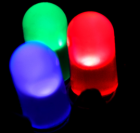 |  |  | 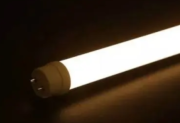 |
| LED Lamp | Incandescent Lamp | Tungsten Halogen Lamp | Fluorescent Lamp |
 |  |  |  |
| Neon Lamp | Xenon Lamp | Sodium Lamp | Mercury Lamp |
Radiometry and Photometry
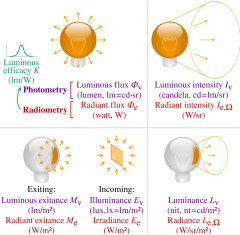
Using the CIE Standard Luminous Efficiency Function as a conversion bridge, it distinguishes between objective physical radiometric quantities (such as radiance, radiant intensity, etc.) and photometric quantities weighted by human vision (such as luminance, luminous flux, etc.). It is a core theoretical tool for light source R&D, lighting design, and imaging system luminance analysis.
Overview of Radiometric Quantities:
| Quantity | Symbol | Definition | Unit Name | Unit Symbol |
|---|---|---|---|---|
| Radiant Energy | $Q$ | $\int_{\Delta t} \Phi , \mathrm{d}t$ | Joule | $\mathrm{J}$ |
| Radiant Energy Density | $w$ | $\frac{\mathrm{d}Q}{\mathrm{d}V}$ | Joule per cubic meter | $\mathrm{J}/\mathrm{m}^3$ |
| Radiant Flux | $\Phi,, P$ | $\frac{\mathrm{d}Q}{\mathrm{d}t}$ | Watt | $\mathrm{W}$ |
| Radiant Intensity | $I$ | $\frac{\mathrm{d}\Phi}{\mathrm{d}\Omega}$ | Watt per steradian | $\mathrm{W}/\mathrm{sr}$ |
| Radiance | $L$ | $\frac{\mathrm{d}I}{\mathrm{d}A \cos\alpha}$ | Watt per steradian per square meter | $\mathrm{W}/(\mathrm{sr},\mathrm{m}^2)$ |
| Irradiance | $E$ | $\frac{\mathrm{d}\Phi}{\mathrm{d}A}$ | Watt per square meter | $\mathrm{W}/\mathrm{m}^2$ |
| Radiant Exitance | $M$ | $\frac{\mathrm{d}\Phi}{\mathrm{d}A}$ | Watt per square meter | $\mathrm{W}/\mathrm{m}^2$ |
Overview of Common Photometric Quantities:
| Quantity | Symbol | Definition | Unit Name | Unit Symbol |
|---|---|---|---|---|
| Luminous Flux | $\Phi,, P$ | $\frac{\mathrm{d}\Phi}{\mathrm{d}t}$ | Lumen | $\mathrm{lm}$ |
| Luminous Intensity | $I$ | $\frac{\mathrm{d}\Phi}{\mathrm{d}\Omega}$ | Candela | $\mathrm{cd}$ |
| Luminance | $L$ | $\frac{\mathrm{d}I}{\mathrm{d}A \cdot \cos\alpha}$ | Candela per square meter | $\mathrm{cd},\mathrm{m}^{-2}$ |
| Illuminance | $E$ | $\frac{\mathrm{d}\Phi}{\mathrm{d}A}$ | Lux | $\mathrm{lx}$ |
| Luminous Exitance | $M$ | $\frac{\mathrm{d}\Phi}{\mathrm{d}A}$ | Candela steradian per square meter | $\mathrm{cd},\mathrm{sr},\mathrm{m}^{-2}$ |
Symbols and conversion formulas for radiometric and corresponding photometric quantities:
| Radiometric quantity | Symbol | Photometric quantity | Symbol | Conversion |
|---|---|---|---|---|
| Radiant Flux | $\Phi_e, P_e$ | Luminous Flux | $\Phi_v, P_v$ | $\Phi_v = K_m \int_{380}^{780} \Phi_e(\lambda) V(\lambda)\,\mathrm{d}\lambda$ |
| Radiant Intensity | $I_e$ | Luminous Intensity | $I_v$ | $I_v = K_m \int_{380}^{780} I_e(\lambda) V(\lambda)\,\mathrm{d}\lambda$ |
| Radiance | $L_e$ | Luminance | $L_v$ | $L_v = K_m \int_{380}^{780} L_e(\lambda) V(\lambda)\,\mathrm{d}\lambda$ |
| Irradiance | $E_e$ | Illuminance | $E_v$ | $E_v = K_m \int_{380}^{780} E_e(\lambda) V(\lambda)\,\mathrm{d}\lambda$ |
| Radiant Exitance | $M_e$ | Luminous Exitance | $M_v$ | $M_v = K_m \int_{380}^{780} M_e(\lambda) V(\lambda)\,\mathrm{d}\lambda$ |