Lambertian Surface
I.Definition
A Lambertian surface (also referred to as a perfectly diffuse emitter or ideal diffuse reflector) is an idealized model in optics, radiometry, and photometry. It is defined as a surface whose radiance is constant in all viewing directions.
In other words, the radiance of a Lambertian surface is independent of the direction of observation, although the observed intensity varies with angle due to geometric effects.
II.Classification
Based on the interaction between light and a surface, Lambertian behavior can be categorized into three idealized types:
1. Lambertian Emitter
A Lambertian emitter is an ideal surface that emits radiation with constant radiance.
- The emission is isotropic in radiance.
- This model serves as a fundamental reference in thermal radiation theory.
Typical example: a blackbody radiator.
 Figure 1: blackbody radiator
Source: https://zh.wikipedia.org/wiki/File:Erbe.gif
2. Lambertian Reflector
A Lambertian reflector is an ideal diffuse reflecting surface that scatters incident radiation such that the reflected radiance is independent of viewing direction.
 Source: https://upload.wikimedia.org/wikipedia/commons/0/08/Lambert6.gif
Typical examples:standard whiteboards or gray cards, walls, and white paper.
 Figure 2: standard whiteboards or gray cards
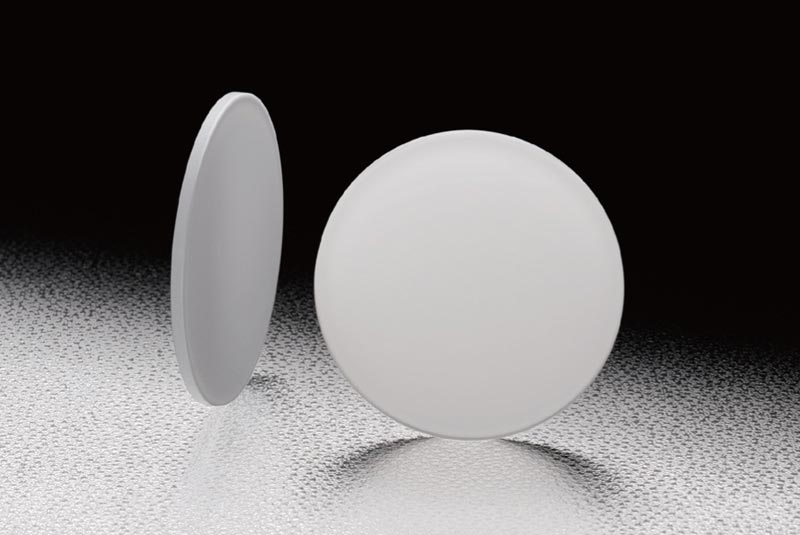
3. Lambertian Transmitter
A Lambertian transmitter is an ideal surface that transmits radiation diffusely, with transmitted radiance independent of viewing direction.
Typical examples: frosted glass and overcast clouds.
 Figure 2: Opal Glass
Source: https://www.ok-kk.com/uppic/upfile/image/guangxueyuanjian/lvguangpian/3547/DFO_p.jpg
III.Lambert's Cosine Law
Lambertian surfaces obey Lambert's cosine law.
The observed radiant intensity in a given direction is proportional to the cosine of the angle between that direction and the surface normal.
$$ I_\theta = I_n \cos\theta $$
where:
- $I_\theta$ is the radiant intensity in direction $\theta$ .
- $I_n$ is the radiant intensity in the normal direction.
- $\theta$ is the angle between the observation direction and the surface normal.