
 This page is not fully translated, yet. Please help completing the translation.
(remove this paragraph once the translation is finished)
Yanding Matrix Traffic Light Helps ADAS Systems Accurately Recognize Traffic Light Status
Introduction
With the rapid development of autonomous driving technology, the environmental perception performance of in-vehicle ADAS (Advanced Driver Assistance Systems) faces severe challenges, among which traffic light recognition is particularly prominent. This article will deeply analyze this technical challenge and explore the innovative application of Yanding's matrix traffic light in ADAS testing.
1. Challenges in Traffic Light Recognition
During autonomous driving, accurate recognition of traffic lights is crucial for driving safety. However, in actual road environments, traffic lights pose numerous challenges to ADAS:
● Multiple Shapes: Traffic light shapes vary across different regions, including horizontal, vertical, circular, and arrow shapes. Some areas also have unconventional styles such as temporary traffic lights and construction traffic lights, which increases the complexity and difficulty of recognition for ADAS systems.
 ● Various interesting traffic lights

● Various Sizes: Traffic light sizes are not uniform, ranging from large to small (diameters of 10cm/20cm/30cm/40cm). Moreover, at different distances, their proportions in the camera frame vary, posing challenges for accurate recognition by ADAS systems.
● Difficulty in Color Distinction: Under different lighting conditions, red and yellow lights have high similarity, making them difficult to distinguish even for the human eye, which often relies on the position of the lights, let alone in-vehicle ADAS systems.
1. At night, the camera's exposure time is relatively long and the traffic lights are bright, causing the corresponding color channels to saturate while the remaining channels are also saturated or near saturation, making the light source appear white.

2. When capturing red lights, the red pixels are more likely to reach saturation than the remaining channels. Alternatively, because red and yellow are adjacent in the color space, incorrect color correction may cause yellow to appear red or red to appear yellow.

● Flicker Issues: When a camera captures traffic lights flashing at a certain frequency, it is prone to the traffic light appearing only partially lit or completely dark, i.e., LED flickering. This interferes with the ADAS system's perception and recognition of real traffic light effects.
2. Difficulties in Reproducing Problems on Actual Roads
In actual road environments, reproducing these problems is highly challenging:
● Uncontrollable Environment: Environmental factors such as weather and lighting conditions change constantly, making it difficult to stably reproduce specific traffic light recognition scenarios.
● High Safety Risks: Testing on actual roads may pose safety risks to vehicles and pedestrians, increasing the difficulty and cost of testing.
● Low Efficiency: Encountering various complex traffic light scenarios on actual roads requires a significant amount of time and effort, resulting in low testing efficiency.
3. Advantages of Yanding Traffic Light Source Instruments
Yanding's traffic light source instruments provide an ideal solution to these problems. The equipment has the following significant advantages:
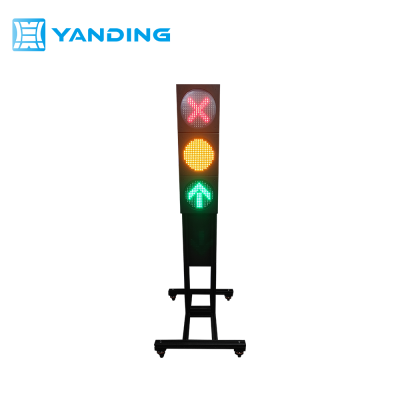
● Simulating Diverse Traffic Light Scenarios: Yanding's traffic light source instrument adopts an LED array structure, integrating red, yellow, and green light-emitting units, with the brightness of each LED bead independently adjustable. It has the following features:
1. Various common shapes are pre-set, allowing users to select and load different shapes, and supporting the custom addition of various shapes;
● Diverse Shape Storage and Instant Switching
It offers 13 default traffic light shapes, supports storage of 26 custom shapes, and features a digital display function from 0 to 99.

● Rich Shape Library Resources
It extensively covers various traffic icons, fully meeting the needs of multiple traffic scenarios.

2. Supports programmatic control via software;
3. Brightness can be adjusted in 0-100 levels to test performance under different brightness conditions, and the flicker frequency can be set and adjusted from 0 to 1000Hz;
4. In addition to using a single standalone traffic light, multiple traffic lights can be daisy-chained to simulate a 3D intersection with coordinated multi-light operation.
● Convenience of Reproducing Problems in the Laboratory: Using Yanding's equipment, researchers can configure the light source environment in the laboratory and reproduce various complex traffic light scenarios at any time, without the need for dangerous and time-consuming testing on actual roads. This greatly improves testing efficiency and safety, reducing time and cost investments.
● Improving Testing Accuracy and Reliability: The equipment provides a stable and controllable testing environment, ensuring the accuracy and reliability of test results. By conducting in-depth research on various traffic light scenarios in the laboratory, the algorithms and performance of ADAS systems can be better optimized, improving their performance on actual roads.
4. Conclusion
The complex shapes and flickering issues of traffic lights interfere with the accurate recognition of traffic light status by ADAS systems, thereby affecting their correct driving decisions. This is an issue that cannot be ignored. However, Yanding's TL-3CD20 Matrix Traffic Light provides a powerful tool to solve this problem. By reproducing various complex traffic light scenarios in the laboratory, researchers can more efficiently test and optimize ADAS systems, improving their safety and reliability on actual roads. If you wish to achieve better results in the R&D and testing of ADAS technology, choosing Yanding's TL-3CD20 Matrix Traffic Light will be a wise decision.