
 This page is not fully translated, yet. Please help completing the translation.
(remove this paragraph once the translation is finished)
CMS Dual-Point Light Source
What is CMS?
With the development of automotive electronics, the Camera Monitor System (CMS) is gradually replacing traditional optical rearview mirrors, becoming one of the core configurations of modern vehicles. It captures images via exterior cameras and displays them in real-time on interior monitors, resolving the pain points of traditional rearview mirrors such as limited field of view and blurred vision in adverse weather conditions.

Why is the dual-point light source test necessary?
During night driving, the bright headlights of trailing vehicles can easily cause artifacts such as glare and ghosting in CMS imaging, severely interfering with the driver's judgment of the rear road conditions. Therefore, the dual-point light source test is required to verify the CMS's ability to recognize and process rear vehicle lights in nighttime environments. A qualified CMS should clearly distinguish two independent point light sources, helping the driver accurately determine the number and position of trailing vehicles and reducing the risk of lane-change accidents.

Logic for Handling Bright Light: Differences Between Traditional Rearview Mirrors and CMS
Compared to traditional rearview mirrors, CMS has both advantages and faces new challenges in dealing with bright light from trailing vehicles. Traditional mirrors rely on prism structures or electrochromic materials for passive anti-glare, whereas CMS actively suppresses bright light through image processing algorithms and optical design, upgrading from a physical reflection tool to an intelligent visual processing system capable of achieving effects unattainable by traditional mirrors. Meanwhile, CMS cameras are equipped with hydrophobic coatings and automatic heating functions, which reduce the impact of water droplets and fogging on imaging in rain and snow, ensuring image clarity at the source.

How to Perform the CMS Dual-Point Light Source Test?
Test Metrics (Refer to GB 15084)
For Class I, Class II, and Class III CMS, the system shall enable the driver to recognize vehicle headlights as two separate point light sources. The Point Light Source Discovery Factor (PLSDF) shall be no less than 2.7, or the Point Light Source Contrast Factor (PLSCF) shall be no less than 0.12.
The Point Light Source Discovery Factor (PLSDF) requires evaluating the horizontal and vertical luminance curves of the point light sources displayed on the monitor. The calculation formula is as follows:
$$\text{PLSDF} = \frac{S_{\text{H}} \times L_{\text{H},\text{max}}}{S_{\text{V}} \times L_{\text{V},\text{max}}}$$
The Point Light Source Contrast Factor (PLSCF) requires evaluating the horizontal luminance curve of the point light sources displayed on the monitor. The calculation formula is as follows:
$$\text{PLSCF} = \left(1 - \frac{L_{\text{H},\text{min}}}{L_{\text{H},\text{max}}}\right)$$
 |  |
| PLSDF | PLSCF |
|---|
Environment Setup

Parameter Requirements for the Dual-Point Light Source Simulator
The dual-point light source simulator simulates a set of vehicle low-beam headlights located at a distance of 250 m. In laboratory testing, relevant conversions are usually applied to conduct the test within 10 m. The distance from the camera to the point light source simulator, $\alpha_{PLS}$, should be within the depth of field of the CMS camera.

Recommended Equipment
Camera side:
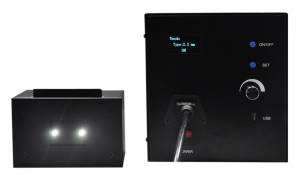

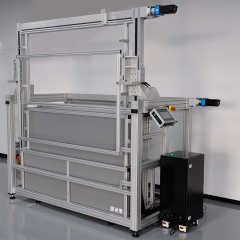
Monitor side:
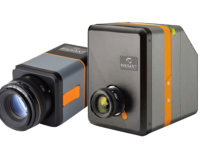
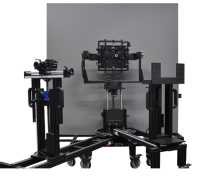
Test Procedure
Camera side:
1. Place the dual-point light source in front of the camera, turn it on, and adjust its luminance to 250,000–300,000 cd/m²;
2. Adjust the camera so that its optical axis is perpendicular to the dual-point light source;
3. Adjust the distance between the camera and the light source according to the spacing of the light-emitting apertures of the dual-point light source (for a dual-point light source with an aperture spacing of 1.3 cm, the shooting distance is 2.5 m).
Monitor side:
1. Adjust the display and the reference camera so that the reference camera is perpendicular to the monitor;
2. Turn off other light sources to ensure the ambient illuminance on the monitor side is below 2 lx;
3. Capture images using the 2D imaging luminance meter.

RIQA Analysis and Interpretation
 If the CMS camera monitor system meets either condition (PLSDF ≥ 2.7 or PLSCF ≥ 0.12), it is deemed qualified. As shown in the figure above, the sample's PLSDF is 4.47032 (≥ 2.7) and its PLSCF is 1 (≥ 0.12); therefore, the dual-point light source performance of this sample is qualified.
The PLSDF reflects the system's fidelity and sharpness in reproducing the shape of the point light sources; a higher value indicates stronger resolving power. The closer the PLSCF is to 1, the higher the contrast between the two point light sources, making them easier to distinguish.