 This page is not fully translated, yet. Please help completing the translation.
(remove this paragraph once the translation is finished)
Multispectral Light Booth — Setting a New Standard for Optical Testing Accuracy, Providing Precise "Calibration" Answers for Every Ray of Light
1. Why Do Colors Differ Under the Same Color Temperature?
Color temperature is a measure of the hue of light. Generally, warm yellow light has a lower color temperature, while cool white light has a higher one. Light that appears to have the same color temperature actually contains different “spectral secrets.” The spectrum is like an “ingredient recipe” for light; even if the color temperature is identical, light sources with different spectra have varying compositions.
Take paint mixing as an example: two paints that look similar may, upon closer inspection, have one with more blue components and the other with more red components. When light sources with different spectra illuminate an object, the object's light reflection characteristics change. For instance, a red garment will appear more vibrant and bright under a light source with a higher proportion of red light; however, under a light source of the same color temperature but with less red and more blue light, the red may appear dull and grayish, resulting in a noticeable visual difference.
The reason is that the color an object displays depends on its reflection of light. The spectral composition of the light source determines the types of light available for the object to reflect. Once the spectral composition deviates, the reflected light changes accordingly, and the color perceived by the human eye will also differ, which can easily lead to errors in the color recognition process.
A simple analogy for light with the same color temperature but different spectra is like two glasses of “white milk”: one is pure milk, and the other is water mixed with bleach. They look the same, but the difference is immediately revealed when making coffee! Color inspection works the same way — different light “recipes” lead to vastly different results.
So how can we avoid this situation and perform accurate color inspection?
This requires a lighting tool capable of providing precise spectra. It is recommended to use the Multispectral Light Booth, which can simulate the spectra of various standard light sources, ensuring that the “ingredient recipe” of the light source is stable and compliant with standards during color inspection. Whether it is checking the color accuracy of printed and dyed products, evaluating the color of food, or restoring and preserving artworks, it provides a reliable and consistent lighting environment, making color inspection results more accurate and avoiding color misjudgments caused by light source differences.
2. Why Choose Our Multispectral Standard Light Booth?
Addressing Pain Points
- In the automotive camera field, have you ever been troubled by issues such as color accuracy, low-illuminance standard light source switching, and low-light noise? It is difficult for laboratories to simulate the light source spectra of real-world road scenarios, leading to deviations between test results and actual applications.
- In the color management industry, display color casts and discrepancies between printed materials and design drafts are common. The root cause is the lack of standard light sources, resulting in distorted color reproduction.
- In medical and industrial inspection, disputes over material color difference judgments often arise. Ultimately, this is due to the lack of a traceable spectral benchmark, making it difficult to ensure the accuracy and reliability of inspection results.
Our Solutions
- With the advanced combination of “precise multispectral reproduction + YD-MSL software program control”, we provide you with a laboratory-grade core tool for optical calibration, comprehensively improving the accuracy and reliability of optical testing.
3. Core Selling Points — Four Technological Breakthroughs, Redefining the “Standard of Light”
1. Reproducing Standard Illuminant Spectra — Full Coverage of Natural and Artificial Spectra
It can accurately reproduce the spectra of Planckian radiators (such as CIE standard illuminant A) and CIE D-series standard daylight illuminants with color temperatures ranging from 1,800 K to 20,000 K. Its spectral matching degree is extremely high, effectively solving the “band gap” problem of traditional light booths, ensuring that the test spectrum is highly consistent with the standard spectrum, and providing a solid foundation for test results.
2. Spectral Fitting — Diverse Options, Flexible Adaptation
Using an external illuminance meter (optional) to calibrate the light source, or inputting externally collected spectral data into the software, advanced fitting algorithms can accurately fit the target spectrum. At the same time, by fitting broadband and narrowband LED spectra, it can simulate the spectra of various light sources, achieving full coverage of the 380 nm - 980 nm visible light wavelength range and meeting the simulation needs for various light source spectra in different scenarios.
 3. Automatic Calibration — Eliminating “Equipment Aging Errors”
With the help of an external spectral measuring instrument, the automatic calibration function of the light source is realized. It can automatically compensate for spectral changes caused by component aging or environmental changes, ensuring that the radiation of the light source is always accurate and stable, providing reliable spectral data for testing over the long term, and reducing test errors and frequent maintenance costs caused by equipment aging.

4. Software Operation — Simple, Convenient, Powerful, and Supporting Automated Integration
The control software features a user-friendly interface and is easy to operate, allowing even personnel without extensive software experience to get started quickly. Meanwhile, to meet personalized needs and system integration applications, it provides APIs (C, C++) required for secondary development, making it easy for users to integrate it into existing automated testing systems or expand functions according to their own needs, achieving efficient automated optical testing workflows.

4. Lighting Environment Setup — Professional Light Sources Assist in Image Tuning
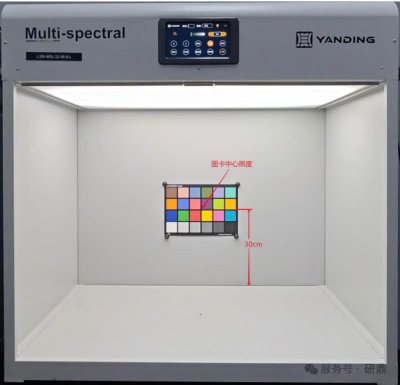
Traditional image laboratory light booths use Spectralight QC light sources for tuning indicators such as white balance, color reproduction, and luminance uniformity. However, they still have limitations, such as the non-adjustable illuminance of A/H/D light sources, requiring additional multi-color temperature adjustable light booths to meet the needs of various color temperatures and different illuminances. Our LSB-MSL26/32-IR Light Booth combines adjustable color temperature, adjustable illuminance, and ultra-high spectral fitting to standard light sources, offering significant advantages.
1. Testing Applications — Rich and Diverse Functions, Simulating Real-World Scenarios
a. It can perform test chart evaluations from extremely low illuminance to high illuminance, meeting image tuning needs under different light intensities. (Especially adept at meeting dark environment testing requirements below 1 lux)

b. Through timing control, color temperature switching can be set in advance to accurately simulate the exposure effect at the moment a car enters or exits a tunnel, providing realistic scenarios for automotive camera performance testing and ensuring stable and reliable image performance during actual driving.

c. With the help of 26/32 LED channels, it can simulate neon light sources of various colors, allowing users to more intuitively evaluate real-scene imaging quality under different light source illuminances. This is of great value for equipment R&D and tuning that need to ensure image quality in complex lighting environments.

2. Standard Light Sources — More Precise Fitting, Stronger Compatibility
a. The LSB-MSL26/32-IR light booth performs even better in fitting CIE standard spectra. Its spectral characteristics are highly consistent with CIE standards, ensuring the accuracy and authority of test results. At the same time, it is compatible with multiple standards, such as ISO 3664, CIE 15, and IEC 62906, meeting the testing standard requirements of different industries and fields, and making the test results more universal and comparable.


3. Data Comparison — Accurately Presenting Differences, Gaining Insight into Details
a. By aligning the color temperature and luminance parameters with those of the QC light booth, using the same module to test images and analyze results under the preset lighting environment, it can be seen that the analyzed data results of the test images measured under the two light booths are closely comparable.


5. Technical Parameters at a Glance
Two Specifications:
- 26-channel visible light band 380-780nm (Visible light model LSB-MSL26)
- 32-channel visible to near-infrared 380-980nm (Including near-infrared model LSB-MSL32-IR)
Spectral range: 380nm~980nm (Optional 380nm~780nm)
Luminance adjustment: 60,000 levels (2000K/3900K)
Color temperature range: 2000~20000K. Compatible standards: ISO 3664, CIE 15, IEC 62906
Control method: Touch screen operation / Provides C/C++ API, supports Python calls, supports Windows 10/11 operating systems (Windows is a registered trademark or trademark of Microsoft Corporation in the United States and/or other countries).
Product Video Introduction:
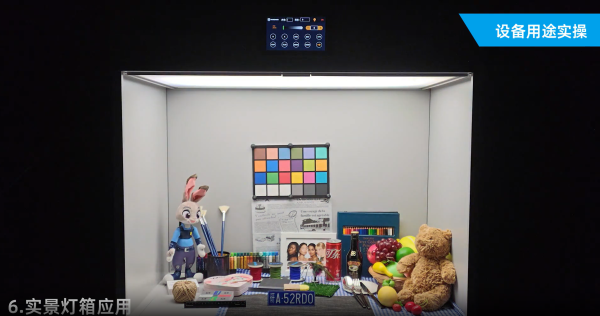
The introduction of the LSB-MSL series multispectral adjustable area light booth opens a new chapter in precise lighting technology. This equipment adopts innovative multi-channel narrowband LED spectral fitting technology, enabling precise control of a wide color temperature range from 2000K to 20000K, while high-fidelity reconstructing the full spectral power distribution (SPD) of natural and artificial light sources. Under standard daylight D50 - D75, the color rendering index reaches CIE Ra > 98. This not only overcomes the color distortion problem caused by the discontinuous spectrum of traditional LEDs but also reshapes the technical specifications of precise light sources, bringing a brand-new solution for spectral-level precise control to the imaging industry, inspection, and other fields.