 This page is not fully translated, yet. Please help completing the translation.
(remove this paragraph once the translation is finished)
ISO 17957: Shading Test
The ISO 17957 standard specifies the shading measurement methods for digital cameras (including camera phones). This method includes test procedures for measuring both color signal components and luminance signal components.
Terms and Definitions
1. Luminance Shading / Luminance Non-uniformity
(luminance shading / luminance non-uniformity)
Gradual variation of the luminance signal component across the image field.
2. Color Shading / Color Non-uniformity
(colour shading / colour non-uniformity)
Gradual variation of the chrominance signal component across the image field.
Apparatus and Hardware
The following hardware is required to control and record the test conditions:
— Uniform field target;
— Light source(s);
— Luminance meter.
Lighting Requirements
Luminance non-uniformity measurement: An average daylight (Illuminant D) light source shall be used;
Color non-uniformity measurement: Three standard light sources shall be used, namely: (1) Average daylight (Illuminant D, CIE D55 recommended, color temperature 5503 K, tolerance 5000 K–6504 K); (2) Indoor incandescent lamp (Illuminant A, CIE A recommended, color temperature 2856 K, tolerance 2700 K–3200 K); (3) Indoor fluorescent lamp (Illuminant F, CIE F2 recommended, color temperature 4230 K, tolerance 3900 K–4600 K).
The light source shall provide uniform illumination without causing glare or reflections from the target.
Camera Settings
a. Exposure adjustment: The exposure shall be adjusted according to the light source luminance so that the average output value of the central measurement patch is between 110 and 130 in sRGB encoding. If the luminance of the edge patches is too low (e.g., in wide-angle lens scenarios), the exposure may be appropriately increased, but the output value of the central patch must be recorded.
b. White balance: The white balance shall be adjusted to “neutral color at the image center” to prevent camera white balance deviations from masking color non-uniformity caused by the light source.
c. Focus distance: The recommended focus distance should be no less than “(35mm equivalent focal length) × 10”. If manual focus is supported, focusing on the test target is not required.
d. Image storage: Images shall be saved at the maximum pixel count and highest quality (minimum compression) format.
e. Parameters to be recorded: F-number, focal length, focus distance, ISO sensitivity, and exposure time.
Target (Uniform Field) Requirements
a. Spectral neutrality: The target shall provide a spectrally neutral and uniform luminance distribution across the entire imaging field of view, and its spectral transmittance or reflectance shall not vary by more than 5% within the 420 nm to 750 nm range.
b. Luminance uniformity: The luminance uniformity across the entire imaging area shall be controlled within 2.5% (i.e., “|maximum - mean| / mean < 0.025 and |minimum - mean| / mean < 0.025”), and must meet the minimum requirement of not exceeding 5% (i.e., “|maximum - mean| / mean < 0.05 and |minimum - mean| / mean < 0.05”). The average luminance shall be maintained between 50 cd/m² and 120 cd/m².
c. Structure and luminous flux: The target can be of a transmissive or reflective structure. The light it emits must be diffuse and shall not contain any specular reflection components.
 |
| Reflective Test Target Environment Setup |
|---|
Sampling Method
The image is divided into (2N+1)×(2N+1) non-overlapping rectangular patches (N≥5). The sRGB values of the pixels within each patch are averaged, retaining floating-point or rational number formats to avoid quantization errors. These values are then converted to linear RGB values and further calculated into CIE L*a*b* values, providing a data foundation for subsequent evaluation metrics such as lightness, luminance, and chrominance non-uniformity.
Evaluation Metrics
Shading and color non-uniformity are evaluated through quantitative metrics across different dimensions:
Lightness Shading $(D_L)$:
$$D_L = \max\left[L^*(i)\right] - \ min\left[L^*(i)\right] $$
Luminance Shading $(D_Y)$:
$$D_Y = \frac{\max[Y(i)] - \min[Y(i)]}{\max[Y(i)]} \times 100$$
Chrominance Non-uniformity $(D_c)$:
When analyzing chrominance non-uniformity, first calculate the average values $ a^*(i) $ and $b^*(i) $ of the test patches, and then calculate the overall average values $( \overline{a^*})$ and $( \overline{b^*} )$ for the entire image:
$$\overline{a^*} = \frac{1}{m} \sum_{i=1}^{m} a^*(i) \quad $$
$$\overline{b^*} = \frac{1}{m} \sum_{i=1}^{m} b^*(i) $$
where m is the number of measurement patches.
The chrominance deviation of the i-th patch is calculated as follows:
$$D_c(i) = \sqrt{\left[ a^*(i) - \overline{a^*} \right]^2 + \left[ b^*(i) - \overline{b^*} \right]^2}$$
The chrominance non-uniformity \( D_c \) is defined as the maximum deviation relative to the overall average, i.e.: $$D_c = \max\left[ D_c(i) \right]$$
Total Color Non-uniformity $D_{\text{Total}}$:
The analysis of total color non-uniformity first calculates the maximum and minimum values of $L^*(i)$, $a^*(i)$, and $b^*(i)$:
$$L_{\text{max}}^* = \max\left[ L^* (i) \right], \quad L_{\text{min}}^* = \min\left[ L^* (i) \right]$$
$$a_{\text{max}}^* = \max\left[ a^* (i) \right], \quad a_{\text{min}}^* = \min\left[ a^* (i) \right] $$
$$b_{\text{max}}^* = \max\left[ b^* (i) \right], \quad b_{\text{min}}^* = \min\left[ b^* (i) \right]$$
The calculation principle for total color non-uniformity $(D_{\text{Total}})$ is as follows:
$$D_{\text{Total}} = \sqrt{\left( L_{\text{max}}^* - L_{\text{min}}^* \right)^2 + \left( a_{\text{max}}^* - a_{\text{min}}^* \right)^2 + \left( b_{\text{max}}^* - b_{\text{min}}^* \right)^2}$$
Yanding Equipment Support:
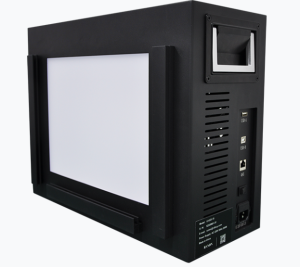
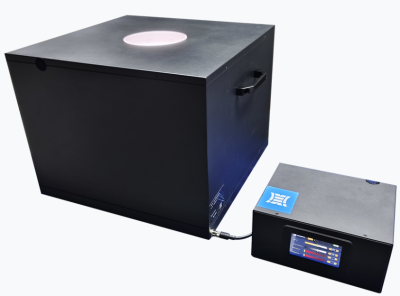
All the above light sources meet the two core requirements of the standard: overall luminance uniformity and diffuse luminous flux, and their wide color temperature range also complies with the test requirements.